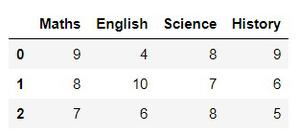
In this article you'll learn how to use Pandas' groupby () and aggregation functions step by step with clear explanations and practical examples. Aggregation means applying a mathematical function to summarize data.
In this tutorial, we’ll explore the flexibility of DataFrame.aggregate() through five practical examples, increasing in complexity and utility. Understanding this method can significantly streamline your data analysis processes. Before diving into the examples, ensure that you have Pandas installed. You can install it via pip if needed:
I've seen these recurring questions asking about various faces of the pandas aggregate functionality. Most of the information regarding aggregation and its various use cases today is fragmented across dozens of badly worded, unsearchable posts. The aim here is to collate some of the more important points for posterity.
In this section, we'll explore aggregations in Pandas, from simple operations akin to what we've seen on NumPy arrays, to more sophisticated operations based on the concept of a groupby. For convenience, we'll use the same display magic function that we've seen in previous sections:
Pandas GroupBy stands as a cornerstone technique for data aggregation in Python, empowering analysts to distill complex datasets into actionable insights. Its ability to summarize vast information troves, identify underlying patterns, and reveal hidden correlations makes it an indispensable tool.
Pandas is a data analysis and manipulation library for Python and is one of the most popular ones out there. What I think its biggest strengths are ease-of-use and clean syntax.
This blog post will take you on a journey through the fundamental concepts, usage methods, common practices, and best practices of DataFrame aggregation in Python.
After choosing the columns you want to focus on, you’ll need to choose an aggregate function. The aggregatefunction will receive an input of a group of several rows, perform a calculation on them and return a unique value for each of these groups. The aggregate function we’ll use here is “sum.”
In real data science projects, you’ll be dealing with large amounts of data and trying things over and over, so for efficiency, we use Groupby concept. Groupby concept is really important because of its ability to summarize, aggregate, and group data efficiently.
Learn how to develop RAG question-answering systems with Python, featuring detailed practical examples, real-world use cases, and step-by-step implementation guidance.
 In this article you'll learn how to use Pandas' groupby () and aggregation functions step by step with clear explanations and practical examples. Aggregation means applying a mathematical function to summarize data.